Blog/How to Tell If a Tree Is Dangerous: A Coastal Georgia Homeowner's Guide
How to Tell If a Tree Is Dangerous: A Coastal Georgia Homeowner's Guide
Most trees that come down on houses, cars, and fences gave warnings first. The owner either didn't know what to look for, or saw it and figured the tree would be fine. This guide is what 45 years of saw work in coastal Georgia has taught us about reading a tree from the ground — the honest warning signs, what they mean, and what to do next.
It's not exhaustive. A trained arborist with a resistance drill and a binocular climb will catch things you can't see from the ground. But if you can spot three or four of the signs below on a tree near your house, it's time to have someone walk it with you.
The five-second sanity check
Before getting into specifics, here's the quick visual sweep:
- Does it lean noticeably? Especially a lean that showed up after a storm rather than gradually over years.
- Is there dead wood in the crown? Bare branches with no leaves in summer.
- Can you see mushrooms or shelf fungi on the trunk or at the base? That's rot you can see — and a lot more you can't.
- Is there a long vertical crack in the trunk? Especially one you can fit a finger into.
- Is the soil around the base lifted or cracked? That's the root plate moving — one of the worst signs.
Three or more of these on a single tree, especially a large one near your house, is reason to call.
1. Trunk problems
Vertical cracks in the trunk
Healthy trunks heal small cuts and scrapes. A long vertical crack that's open enough to see daylight through (or fit a finger into) is structural damage that won't heal. The trunk has been compromised by wind, lightning, or internal rot, and the crack is propagating. Big cracks on the trunk of a big tree near a house are one of the few things that genuinely qualify as "take it down soon."
Multiple trunks meeting in a tight V
When two large stems meet in a narrow V (a "codominant stem"), the joint between them often contains bark trapped inside — "included bark." That's a weak point, and the bigger the two trunks get, the more weight is pulling on the weak joint. After a storm, this is where trees commonly split clean in half. Common in live oaks, water oaks, and some pines.
Mushrooms or shelf fungi on the trunk
Visible fungi on the trunk almost always indicate internal wood decay. Different species mean different things, but the rule of thumb is: if you can see fruiting bodies (mushrooms, shelves, brackets) on the outside, there's significant rot inside. Trees can stand for years with rot, but they fail unpredictably — and usually under normal wind, not in a storm.
Cavities or hollow areas
Holes in the trunk where wood has rotted away are a structural issue. A useful rule from forestry: if the remaining sound wood is less than about a third of the trunk diameter, the tree is at high risk of failing. You can't always tell this from the outside — what you see is the visible cavity, not the rot extending around it.
Bark coming off in large patches
Bark sloughing off the trunk in big sheets is usually a sign the wood underneath has died. Some species (sycamore, crepe myrtle) shed bark normally; that's not what we're talking about. We're talking about bark falling off areas of an oak, pine, or pecan that previously had intact bark.
2. Crown and limb problems
Dead wood in the crown
Look up. Dead branches in the canopy of a living tree are common — most trees have a few. What you're looking for is the proportion: if 25–30% or more of the canopy is dead, the tree is in serious decline. If the top is dead while the lower branches still have leaves ("crown dieback"), the tree is dying from the top down. That's a slow death usually, but the dead wood up there will start dropping before the tree itself comes down.
Branches hanging up in other branches
A "widow-maker" is a branch that broke off but didn't fall — it's caught in the canopy, waiting for wind or gravity to bring it down. If you can see one, it should come out. Don't walk under it, don't leave kids playing near it, don't ignore it.
Recent storm damage that left hangers
After every named storm we get calls about this. A storm breaks a limb partway through but the wood didn't fully separate, so the broken limb is dangling. These don't fall on a schedule. They fall when the next gust pushes them past the breaking point. Get them down.
3. Root and base problems
The most dangerous signs are usually at the bottom of the tree, not the top.
Lifted soil on one side of the base
If you can see soil heaved up or cracked on one side of the tree — often the side opposite the lean — that's the root plate moving. The tree is in the process of failing at the roots. This often happens after heavy rain when saturated soil can't hold the roots' grip anymore. Lifted soil at the base of a leaning tree near a house is the closest thing to a 911 in tree work.
Visible root damage
Trenches near the tree (for utilities, irrigation, foundation work) often sever major roots without anyone noticing. The tree can lose 30%+ of its anchoring roots and look fine for a year or two — then come down in a storm because the structural support is gone. If a major tree near your house had construction or trenching work within 20 feet of it in the last few years, it deserves a closer look.
Mushrooms around the base or in the root flare
Fungi at the soil line — especially honey-colored ones (Armillaria) or large shelf brackets — usually mean root rot. The tree is being eaten from the bottom up. By the time fungi are this visible, the rot is often advanced.
A new lean after a storm
Trees that have always leaned at the same angle are usually fine — they grew that way over decades and the roots adapted. A tree that was upright last week and is now leaning 10 degrees after a storm is not fine. Something underground moved. Call.
4. Species-specific signs in coastal Georgia
Pines (loblolly, longleaf)
Coastal pines fail in two main ways. Pine bark beetles kill the tree from inside — look for popcorn-sized white "pitch tubes" on the trunk where the beetles entered, and rapid browning of needles over a few months. Second, pines are shallow-rooted compared to hardwoods, so they fail in saturated soil during summer storms. A pine that's leaning toward the house after heavy rain is a more urgent call than a leaning oak.
Live oaks
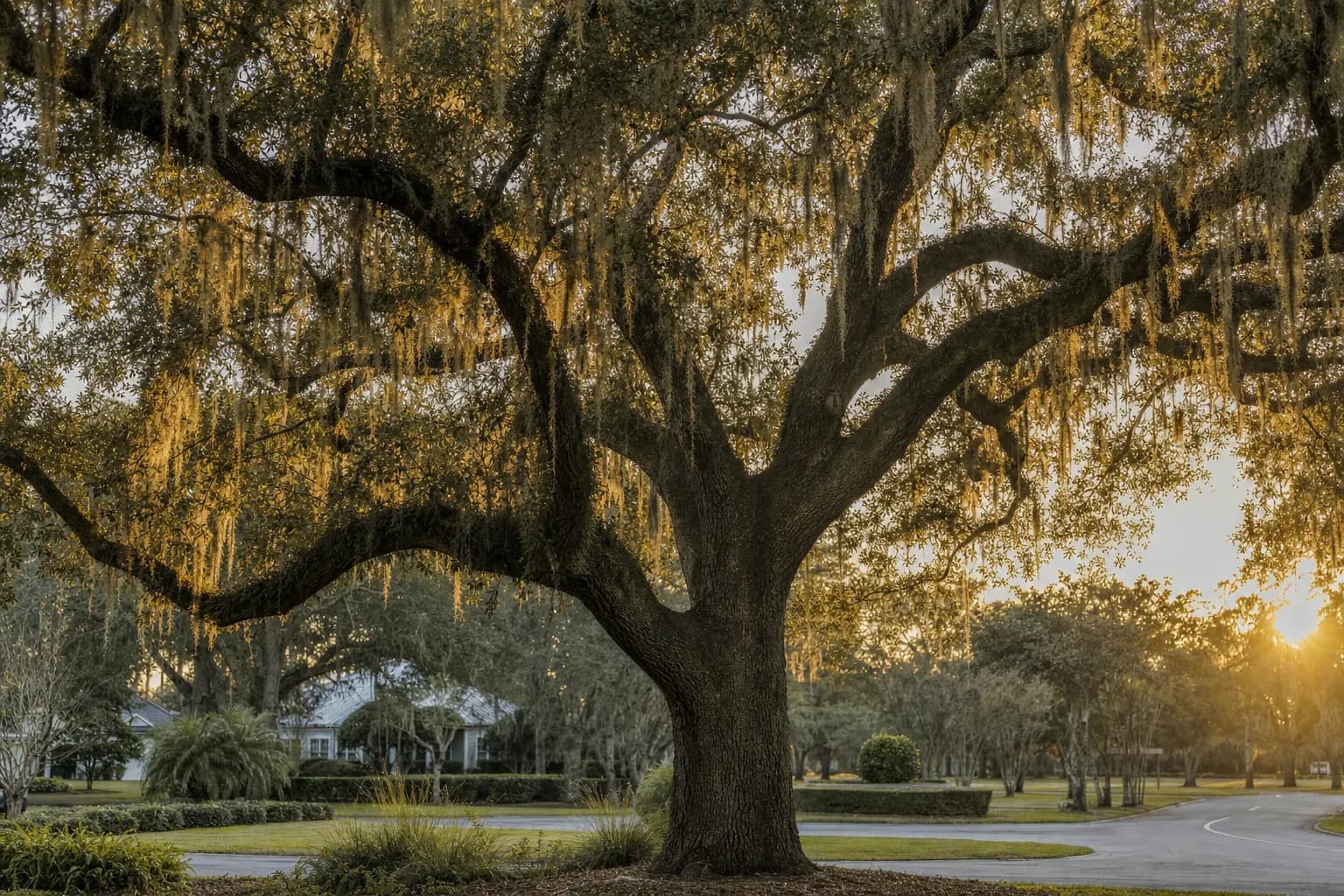
Live oaks are very strong but very heavy. They rarely fail from wind alone; they fail when a major limb develops a crack at the trunk joint or when the root structure is compromised. Watch for cracks at the joints where major limbs meet the trunk, and for dead leaders in the canopy.
Water oaks
Water oaks are the most common "tree on the house" call we get in the Savannah metro. They're fast-growing, structurally weaker than live oaks, and prone to internal rot as they age past 50–60 years. If you have a mature water oak within drop distance of the house, get it inspected.
Pecan trees
Pecans drop heavy limbs without much warning. They're especially prone to limb failure during ice or heavy fruit loads. Brittle wood + heavy nuts + occasional ice events = a tree that needs more regular trim attention than most.
5. What to do when you spot the signs
If you see one or two minor signs, you probably have time. Schedule an inspection on your timeline — the next month or two.
If you see three or more, or if any of these apply, treat it as urgent:
- Heaving soil at the base of a leaning tree near a house
- Long vertical crack in the trunk of a large tree near a house
- A new lean that wasn't there before a storm
- Major hanging limbs over walkways, driveways, or roofs
Take photos. Get a few quotes if it's not an active emergency, one if it is. A real assessment from someone who climbs trees for a living will tell you whether the tree can be saved with selective pruning, needs to come down soon, or needs to come down today.
When to call an emergency tree service
Active emergencies — call right now:
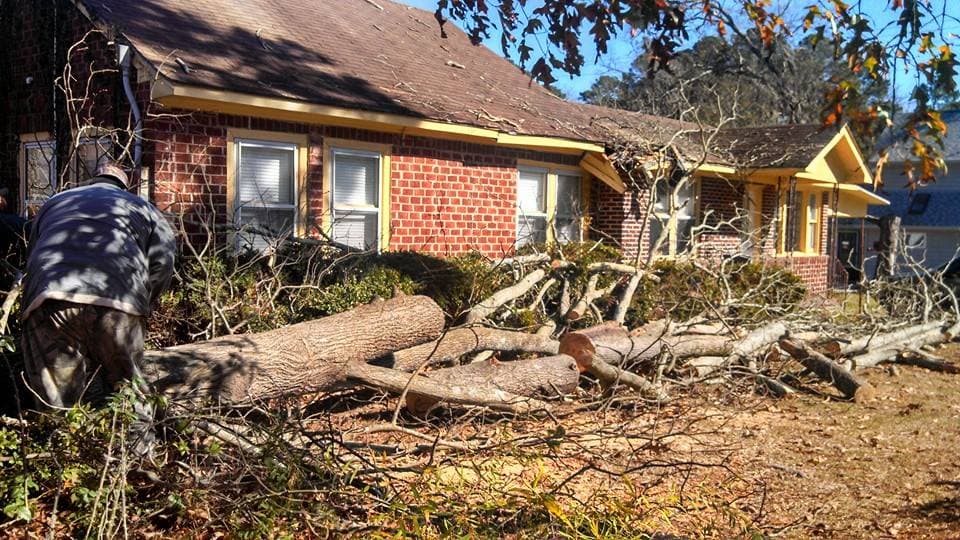
- Tree on a house, shed, garage, or vehicle
- Tree across a driveway you can't bypass
- Tree across or hanging on power lines (call your utility too)
- A tree that's actively cracking or leaning further as you watch
Our emergency line is 912-631-3987 — Steve answers most calls personally. We treat trees on structures, blocked access, and hazardous leans as same-day or next-day priority across Effingham, Savannah, and Bryan County.
Quick reference checklist
Print this and walk your yard once a year — especially in spring before storm season and fall after hurricane season:
- Long vertical cracks in major trunks (worst sign)
- Heaving or cracked soil at the base of a tree
- Mushrooms or shelf fungi on trunk or root flare
- Major cavities or hollow areas
- Dead wood > 25% of the canopy
- Codominant stems with included bark
- Hanging or broken limbs not yet on the ground
- A new lean since the last storm
- Trenching work within 20 feet in the last few years
- Pine bark beetle pitch tubes (loblolly / longleaf pines)
Spot something concerning? Send a photo through the contact form or call us. We'll tell you whether it's worth a closer look — no hard sell, no pressure.
Need a hand?
Free estimate — same day.
45 years of saw work across Effingham, Savannah, and Bryan County. Call Steve directly, or send a quick form and we'll get back today.
Keep reading
Hurricane Tree Prep for Coastal Georgia: Before, During & After the Storm
Hurricane season tree prep, what to do when a tree falls on your house, and how to find a tree service that won't ghost you mid-job. Specific guidance for Effingham, Savannah, and Bryan County homeowners.
Stump Grinding vs Stump Removal: What's the Difference and Which One Do You Actually Need?
Most homeowners hear both terms and assume they're the same thing — they're not. Here's how stump grinding works, when full stump removal is worth it, what each one costs in coastal Georgia, and the right call for your yard.
Tree Removal Cost in Savannah, Effingham & Bryan County — 2026 Homeowner's Guide
How much does it actually cost to take a tree down in coastal Georgia? What drives the price up, what brings it down, and the typical price ranges for the most common Savannah-area tree removals — from a 45-year saw operation.